Abstract
Sociality, which in Psyche and Society has been studied with all the data traceable in books, magazines, documentaries, has its origin and genetic root in the animal stages crossed by our phylogenesis, as reported in Psychosocial Origin of Man. From the detailed analysis of human societies, from the most primitive to the current ones, an analysis carried out in Naked History, the types with ecological factors and transformations have been identified, united in the Historical Framework of Civilizations. In this summary article we will see how the relationships between humans are structured, the common motivations, the types of aggregates and consequently how history develops. Less than 8,000 years ago, sapiens began to implement its potential. The initial agro-pastoral revolution greatly multiplied the species, pushing it to create increasingly larger societies until it covered the entire planet, accompanied by billions of artifacts, expressions of its powerful creativity. Beyond forms, all humans have the same fundamental needs (nourishment, expansion of territory, management of power, hope in eternity), and following one or the other, crowds are born and organize themselves into societies, institutions, sects, parties, companies. They proclaim common ideals and certainties, which soon become fideisms and fanaticisms, taking on the character of obsessions: human masses often converge in collective psychoses. Therefore, among humans, recurring relationships realize a plot, but this occurs only in two typical ways, like tracks that channel crowds and societies, such plots are hierarchies and markets. The importance of work is enormous: it is about understanding societies, history, human nature.
Keywords
Historical Progress, Social Plot, Hierarchy, Market, Hinge, Collective Psychosis, Discomfort of Civilization
1. Relationships by Modality
History is the totality of facts that manifest our humanity, born from the potentialities detected in the previous chapter, especially creativity or ingenuity. It also reveals our animal roots, the nature of a living being with a long past printed in the DNA that conditions us in a heavy and decisive way. Let's try to capture the essence.
We are dealing with Homo sapiens. Which is placed in kingdom of animals that appeared 700 million years ago as heterotrophic living beings, without photosynthesis and unable to produce the substances necessary to sustain themselves, so they must take them from other living beings, and it is food. Furthermore, they must live, that is, survive predators and other dangers that can harm them and make them die. Having to eat and be in a safe position, it remains useful for the animal to have its own territory or area that it keeps under control and from which it keeps away its conspecifics, obviously apart from the opposite sex to reproduce. What for animals is territory for humans is private property or personal possession of goods, for peoples is the homeland: safe area where they can find food and shelter continuously, when they need it, indeed, always. As a heterotroph, man needs food and other goods that he draws from territory that, to be rich and safe, expands on nature but also with respect to his fellow men, with them or against them, in this following a certain possible way of relating.
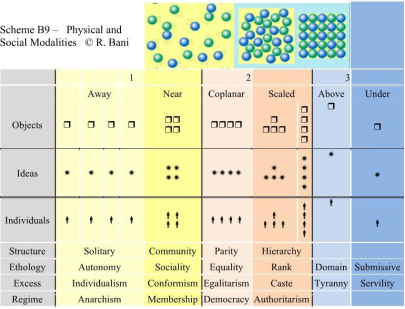
Figure 1, I facilitate the explanation by referring to simplicity of physics: observe several objects and their spatial positions, such the four placed above. Note that there are natural consequential ways for which they can be related to each other as follows: 1) distant and isolated or close, thus giving a whole in which they can be 2) on the same plane or on different planes, and in this necessarily 3) someone is above and others below. Ideas, mental copies of objects, but also animals and human beings, have the same modalities. In addition, ideas and feelings lead to action, and their average characterizes population by giving social relations that are fundamentally physical and spatial relations.
1.1. Isolates or Aggregates
Distant objects are isolated or interact randomly, so the global system appears chaotic. If the feelings and thoughts of individuals, factions, parties, institutions, are directed only to themselves and their own interests, they are dispersed everywhere and pushed against each other, we will have antagonisms, quarrels, conflicts, civil wars, that is, anarchism or social chaos. Close objects form a whole, the individuals a community that demands good agreement, concord in families and among its various parts. This is facilitated by a common culture and a unitary and shared ideology, by a widely accepted value system that is developed and implemented among people and social partners, who respect and pay homage to it.
Figure 1. Physical and social modalities.
1.2. Equal or Hierarchical
Nearby objects can be on the same plane, coplanar, the people in equality and mutual respect; as long as everyone, or almost, is aware of civil values, and respect the laws decided in common: democracy needs ethics among people. But things and people can be on different scalar planes, i.e. in hierarchy with rights at top and duties at bottom.
1.3. Above or Below
From not being on the same level derive two obvious positions: someone is above, as leaders, commanders, presidents, dictators and tyrants; and others below as subordinates, subjects, followers, slaves. Often in internal conflicts a man, or party or institution, prevails and arrogates itself all the rights, and by stiffening the hierarchies and the State will have total power; it will be a violent regime, and all the speeches, ideology and proposed values will have no importance.
Relationships and balance allow for further steps.
Let’s consider a system composed of many similar units that can be linked or unlinked depending on their qualities but also according to the surrounding conditions which make their structure variable until new balances are found. With a simple well-known comparison: water, which, like many substances, goes from vapor to liquid to solid. A hydrogen bridge bond is formed between two water molecules that hold them together and can repeat and increase. If in a set of water molecules there are no bonds, they are isolated and dispersed (Mode 1) and it is steam, if there is one for each, molecules are aggregated but mobile and it is liquid (Mode 2), with all possible bonds all the molecules are rigidly inserted and blocked in crystals, and it is ice (Mode 3). The formation or dissolution of hydrogen bridges’ bonds depends on the molecular qualities and the conditions of temperature and pressure in which they are found.
This is what animals and humans do in social structures, changing them according to the advantages they procure, but invariably following enduring internal qualities, the psychic drives. If in physics the three modes indicated exist and every set can disintegrate or aggregate, a generic human population or animal population can move the elements from isolated and distant to equal neighbors to hierarchical neighbors. We have seen that this has followed two very different paths: the genetic social evolution in animals, see the first part of the book Sociobiology, the social and cultural evolution in the human species, see the second part of Socioanthropology.
The two paths, and phases, are decisive for humans.
Prehistorical phase, slow and genetic, where selection favored sociality and its affirmation through progressive stages in ever larger units but all face-to-face because their members knew each other
In a long archaic genesis, feelings have been formed in solitary territorial animals, hence the attachment to areas and money for possession, avarice, jealousy, then in polygamous and hierarchical groups. Until the appearance of bonds between more males and more females of about the same age, human friendship, changed the conflicting groups with a marked hierarchy in quieter and more communal groups. It was the ultimate and properly human stage in which the feelings that we find best and virtuous were forged: genius, ambition, resourcefulness, audacity, friendship, piety, understanding, compassion, collaboration, concord, sincerity, solidarity, justice, wisdom, dignity, fortitude.
Thanks to union of the minds and forces, the common culture and solidarity, the tribe has victoriously faced the open spaces of savannah, the predators, the impervious mountains and the infinite sea. Intrepidity pushed human beings into the most remote corners of the planet, where the mutability of climates and conditions and the perennial danger of the unknown did not frighten their brotherhood.
Historical phase of rapid social-cultural transformations
With the agrarian revolution the organization into clans and tribes remained essentially unchanged, moving to agricultural and pastoral tribes, with the urban revolution everything changed. Farming produced and nourished, the villages prospered, having become populous no longer allowed them to know and regulate themselves personally, to have equality, direct democracy and exchange of goods in a climate of concord and friendship. Cities were born surrounded by countryside they controlled, city-states, then everything grew. While domesticating nature, sapiens domesticated himself: as he grew in demography, he gave rise to the masses whose organizational problems made the tribal form obsolete, and they threw themselves into history.
2. Social Structures and Hinges
Massification changed the balance, breaking and creating bonds gave rise to new social structures but also underlined, making them very conspicuous, certain basic tendencies that are proper to human nature.
An animal lives on its needs and tries to satisfy them in nature by rummaging through it according to its mental endowments. With vast knowledge and ingenuity, sapiens turned nature upside down, submerging it with the multitude of its forms and artifacts. However, beyond the very different forms, all human beings and their aggregates respond to some basic needs. Just as the door rotates, assuming different positions without detaching itself from the hinges that limit it, so we humans turn to everything that surrounds us, to the absolute, to nature, to social, to control and take advantage of it.
I will call Hinges the following fundamental needs that so much color personal and collective life.
2.1. Absolute
The drama of death, with the desire to remedy it with Eternity, unites humans and nourishes religions that, beyond the various prophets, saints, priests, revelations, doctrines and rites, all respond to this need: to shift from the limited human condition to the absolute dimension. Thus, the Catholic Church to those who assimilate the creed, submit to the clergy, and follow rites, promises salvation in heaven, so it is with Protestants, Orthodox, Muslims, Buddhists: all religious faiths of all times promise life after death, and it is their indispensable hinge. To no longer be, to disappear, is the drama that always nourished the hope of an afterlife with which to soothe it. To the point that a well-planned afterlife may seem so tempting to fideists that they commit suicide. The longed-for hinge is an absolute that always stays, apostles, believers and bearers of a faith assure us of this, we are attracted by it, and it is by hoping for eternity that we adopt a doctrine, its sect and rites. All religions promise and live by this.
2.2. Nature
Man has crossed all continents and scoured all corners of the planet; he has settled where possible, adapting the environments to his needs with works of Anthropization: he has drained swamps, cut down forests, terraced mountains, and even snatched land from the sea to create fields, pastures and more. This is normally done in aggregates called firms, corporations, or economic enterprises.
2.3. Social
As heterotroph, man needs food and other goods that he draws from his territory, which, to be sufficient and safe, he expands with or against his peers, following the relations we’ve already seen.
Structure is a constitutive quality of the universe, from atoms to living things to stars. We are faced with a structure when the elements of a whole are not loose but articulated with each other, assuming a physiology that expresses certain qualities. Thus, the repetition of relations of a given modality creates a coherent social framework that expresses certain qualities, demands a certain habit from those who are part of it, provides them and everyone with a justification or alibi as to why it exists and imposes its management and hegemony. The relational modalities according to which humans’ structure themselves are neither random nor unlimited.
2.4. Community Is Structure Due to Repetition of Equal Relations
Given human nature, even if there is self-interest or privatism and even with command/obedience relationships, these relationships are entirely secondary to the primary principle of peaceful egalitarian coexistence. This requires Communitarism or sense of community as a coherent, necessary, and useful habit for feelings of friendship, sincerity, collaboration, and solidarity. The sense of Belonging is the hinge: desire and pleasure of being part of a group that one respects and trusts, in which one lives willingly for patriotism, feels part of the common territory and history. Communitarianism as a push towards the outside and belonging as an internal pleasure complementary and require knowledge of each other, esteem and trust, and therefore, the pleasure of being together. This is easy in face-to-face groups, families, clans, villages, neighborhoods and small towns: this does not depend on the economic form but rather on the fact that they are small stable groups, in which feeling part of it and participating becomes an important way of functioning.
Vast aggregates born with civilizations depress communitarism and its hinge, the Belonging pleasure, even if its vestiges remain in sentiment of homeland and people of many civilizations: even in large societies the hinge of Patriotism typical of the right and Egalitarism remain, as is tradition of the left. This does not change the original problem: omination has formed us into egalitarian communities. Small groups of great harmony and solidarity where strong and well-united individuals gave strong tribes with decisive impact on environment. A cohesive and efficient community born, forged, by millions of years of selection in a matrix of the best human feelings, optimal state of the person. Its loss is the main cause of civilization's unease.
Urban revolution is the true matrix of history. It has led to the production of millions of artifacts but also to the reshaping of social organization, which has become inexorably complicated. To masses are imposed the State, institutions, laws, taxes, writing, mathematics and geometry, armies, empires and great wars; with them, theocracies and absolute regimes were born. They favored crafts and trade, roads and shipping, freedom and delegated democracy. Everything takes place in two distinct networks of relationships: Hierarchy, which is useful for the management of crowds, and the Market, which is useful for the production and distribution of goods.
Hierarchy is structure due to repeated relations of dominion /submission.
Made possible by the feelings that appeared in ancestral primates to motivate hierarchical ethology and used in families, companies, parties, institutions, and civilizations, which require this to function but if they exceed, they exacerbate them by fixing human beings in authoritarian personalities and societies. It is a modality imposed by numerosity because the masses are not able to govern themselves, so they delegate power to a summit and pyramidal levels; it pushes the crowds under a leader who, with his centralism, compacts them and organizes them into sects, parties or societies. To stabilize itself and justify its hegemony, it adopts an ideal support from the absolute: the divinity delegates to sovereign and pope, historical destiny justifies the political leader as the communist or fascist dictator. Ideology is a constellation of values as a construct of Mind that elevates a man's power to a higher value far beyond the facts. Hierarchism is a coherent habit, hinge is the desire and pleasure to be part of an important, prestigious, powerful institution: it is Power or control of others. As always, feelings count while words serve to convince, plagiarize, dominate the crowds.
Scheme B3 traces how the agriculture spread was followed by population growth, village expansion, and hierarchical superstructure, screwing civilizations into larger societies. Security lies in rank, therefore in the dependence bonds, in the place occupied in pyramidal plot that alone allows the masses to be managed; with the sovereign or head at top and the power that alone can descend on the people. Thus arose the Collectivist City-States that would give rise to the Regional Theocratic Empires of irrigation and later related civilizations.
Market is structure due to repeated exchanges of goods and money between the various personal properties.
Appeared to motivate animals to control an area useful to life, feeling of possession recur in child's actions which, carried out in neglect of parents, emphasize his loneliness. With handicrafts and the exchange of commodities, the interweaving of which gives the market plot, the feeling of possession becomes profitable again, exalting individuality qualities to the point of exasperating them in individualism, autonomy in solitude, possession in avarice, cunning in fraud. If Privatism is a coherent habit, the typical hinge is Freedom: a splendid ideal that has moved people, groups, parties and peoples to historical upheavals.
Trade and market amassed wealth, giving rise to Private City-States and then to Slave Merchant Empires. The Roman Empire fall with advent of barbarians brought back the primary problem of aggregating and governing the masses, a problem solved with the hierarchies of feudal lords and clergy, colored of theocracy. On the contrary, much of the second millennium history is characterized by the decline of feudal institutions and absolute monarchies until the Great War. Although attempts to restore fascist regimes, from Mussolini to Pinochet, and the falsely innovative communist regimes are still based on rigid hierarchies and violent authoritarianism. However, the imposition of privatism is overwhelming. Sustained by the vast, massive technical-economic development that took place from the Merchant Companies of the 1600s to the Industrial Societies up to the present day that show it completely hegemonic in permeating every aspect of life. So much so that it leads individuality to exceed in individualism: everyone thinks and lives for himself, hence the difficulty of agreement and social trust, it distances himself from others and from the laws favoring indifference, antagonism, division, that can lead to disintegration, chaos, anarchy.
Anyway.
You are free when you can manage by yourself what you need to live. When you manage another's resources, you dominate it. If you say you're doing it for his own good, you're a hypocrite. That is, the phrase "property is theft" is stupid. The fact that millions of people believed it casts enormous doubt on human intelligence in its ability to understand the truth. In history, egalitarian democracy does not exist and cannot exist, those who support it are idealists or cheats: hopes, revolutions, democratic motions are born of the best feelings but are impracticable in the masses. It is the fatuous and illusory dream of a society of equals that can only exist in small, durable groups.
Society is therefore a fluid system whose elements can divide or aggregate, passing from solitary to close, from egalitarian to hierarchical, and vice versa; the whole structure can pass between anarchism, democracy, authoritarianism, according to the thoughts, values and average feelings of individuals. Precisely: the relationships dictated by society first induce the use of a certain ethology, then motivate it with coherent feelings, finally the mind supports them with alibis, pseudo explanations. Thus, the rise of a socioculture occurs due to positive and advantageous material factors and/or ideals that create cohesion and allow it to expand, while the descent occurs due to negative material factors and/or ideals that remove cohesion, harden it and contract it. Converging or divergent forces: the trust/distrust duality applied to a community helps to understand the cycles of societies. Positive spiral is due to advantages esteem trust and favors the rise, while the negative spiral due to disadvantages or damages disesteem distrust, facilitates the fall. We turn to Privatism for the well-being and freedom it brings, but when it slips into Anarchy it becomes harmful and we flee from it, seeking Hierarchy under a prestigious leader who organizes and spreads security, and it can result in harmful Authoritarianism with constraints and violence from which we flee.
Anarchism, social chaos arises from the individual’s inability to find agreement and mutual trust because everyone thinks and lives for himself, thus fostering discord, antagonisms, clashes. Authoritarism, of any color, is well able to control people through hierarchies, in ideas and in practice, but without equality because everyone must suffer under bosses. Of course, the ideal would be to avoid excesses whereby the system is organized in privatism and hierarchism but moderate and predominantly based on community, where values, trust and feelings of one's homeland and history are primary. On a material level, by giving work and services to everyone, on ideal level we need to believe in it and feel obliged to moderate and adapt. Democracy requires harmony in culture and good agreement between people, at least in the vast majority since there are always dissidents. Moreover, it requires clear ideas about how society works, to know the needs and understand human history, to draw from it a high but concrete civic ethic in support of a modern but pragmatic society.
But it’s not easy.
History is the anthology of trials and errors to be consulted and understood. Two different types of relationships have emerged that give the plots of hierarchy and market. We cannot do otherwise: they are the edges in which human adventure flows.
3. Collective Psychosis
Vittoria, May 28-29, 2023
It is a dehumanized humanity that I am talking about. A humanity that has lost forever those conditions in which its most mature, virtuous, and best psychism was formed. Homo sapiens spent more than 90% of its genetic history, preceded in similar conditions by Neanderthals, Erectus and others, in face-to-face groups where there was a personal bond between members based on mutual knowledge, sincerity, trust, familiarity, loyalty, friendship. Close and direct relationships that culminate in looking each other in the faces where mimicry dominates, an arcane spontaneous expression of our emotions.
But the phenomenon of vibration is broader.
Anxiety trembles. Is a restless species that runs through history. It invades planet corners, settling where it finds resources and creates various aggregates in companies, sects, institutions, civilizations, combined with the great variety of artifacts, clothes, buildings. Uncertainty dominates everything, the mistress of a basic mistrust that pushes us to seek certainties, a perennial anxiety that spurs humanity to find solutions, to discover or invent the new. With reasoning and imagination, humans strive to satisfy the needs that, being common, induce them to aggregate, in the climate of anxiety, uncertainty, discomfort, they rely on what gives security, especially the hinges.
Absolute is sought in the desire of Eternity.
Nature is rummaged in the desire of Anthropization.
Social where they are important:
Relationships > structure > territory > habit > alibi > hinge
3.1. Isolates or Aggregates
An individual, if Single, does not join others and can only count on himself and his personal territory; he relates with others through exchanges in Market structure that requires dress the Privatism and the hinge is Freedom.
Individuals with others give the crowd or People with absent or initial structure so that it is only a set in which the coherent habit is the sense of Belonging or community and has common territory or homeland to which one is tied by Patriotism.
3.2. Equal or Hierarchical
Individual with others is an aggregate with prevailing horizontal relationships in equality; the related structure is a community where common territory prevails, and habit and hinge are Equality.
Or it forms aggregates with prevailing vertical relationships, i.e. of rank in Hierarchy structure where territorialism of the top prevails, habit is Hierarchy and hinge is the feeling of Power for which it loves to command or obey, to be a guide or follower.
We need trust, we need security, far beyond the many artifices and toys with which we can surround ourselves. We need great values and maximum certainties for which we entrust ourselves to personal goods as territory, or to a head, a leader or messiah, whom we and our fellow human beings reflect in and who can save us from the psycho-social malaise in which we live, from the anxiety in which we swim.
Myths, mythologizing: finding, acquiring, values so high as to eclipse anguish, capable of lifting us from the everyday, ordinary, insipid existence.
Man seeks myth. Humanity craves myths, seeks them, finds them, exalts them, places them on its altars, on the podium of primates where, full of light, they excel; He loves to share them with others because he reflects them, looks in the mirror and thus confirms them. Whether they are true or false will come later. Myth is something of such high value that it can become total, absolute, indisputable and dominate the Ego: subjected to reason and reality it becomes relative, so there can be no doubt about it, because it would lead to rejecting it. Only reality, after an adequate period of time, tells us whether a myth is true or false beyond the emotional lens through which it is viewed. Of course, the mental universe in which the Ego is immersed and on which it lives is fundamental, it is its home, its psycho-mental territory, and this universe finds it useful and normal to have fixed points, bright points with which to orient itself in its night. Distant and bright stars are myths, the high values bearers of certainties. Because every human being lives on the trust he places in things and in life, all the more so he lives on certainties, to the point that they become fixations, obsessions, psychoses. And it loves to share: the Ego loves to see in the Other the same certainties, its faith and even obsessions, having faith and having it with Others, sharing ideals to the point of obsessions is reassuring. Thus, alone or united, humans seek the rewarding myths, the certainties that reassure, everywhere, in every sector. Even more so the modern world to which we have become accustomed to widespread communication. Singers and bands bring thousands of fans to their concerts, actors and actresses with movies, television stars and prominent politicians, religious leaders, and other important figures.
But in history there are no singers, no films, no television, but the hinges. Where, rather than explaining the absolute, it is yearning for eternity that drives crowds to a faith, its rites and officiants; More than knowing nature, it is anthropization that unites agricultural, livestock, fishing, mining and industrial enterprises. In the same way, social solutions are sought. We see enlargement of one's own territory, the growth of personal well-being, in the enlargement of social territory or homeland with patriotism, or by taking away wealth from those who have it with egalitarianism. And there are many of us, and we can converge in a crowd, a movement, a sect and a party to pursue one or the other hinge. Or deprecate and overthrow the existing power with one's own hierarchy, as a leader or a wingman, in order to have freedom or acquire one's own power.
Socio-Psychosis: in what has been said there is the collective dimension.
Whether it is a family or group, a company or party or institution or an entire socio-culture, we share values, certainties, myths and obsessions with others, and by reflecting in them we confirm and strengthen them. If there are many of us, this is even better if a leader, a guide, a prophet or saint or similar, knows how to speak, convince, suggest, as I said in the psychology of the crowd, confirms them, excessively elevates our certainties and obsessions. He is the healer of everyone's discomfort: he takes care of us; He will save us! The masses come together under a leader and assume fanatical certainties, obsessions. Egyptian society, classical Greece, republican and then imperial Rome, Christianity, Islam, the European Middle Ages, then Renaissance, the countries of the Reformation and Counter -Reformation, Napoleonic France, liberal democracies, the societies of communism, fascism, Nazism, the world today. A movement is born, the crowd begins to organize itself under a leader with values and certainties, an ideology and a faith. But it soon competes with other similar ones and becomes a sect, exasperating values into myths, faith in dogmas and obsessions, it becomes fideism. Every crowd, faction, party, institution, people, nation, lives on its myths, its certainties, its obsessions to the fanaticism, to go on for a few hours, the time of a concert or a procession, or centuries, at last be useful or harmful.
A collective myth such like the Italian Risorgimento or fascism is useful or harmful, how to evaluate it and who says so? Of course, if Mussolini had stopped at the conquest of the empire, he would have been seen as positive and the rarefied anti-fascists’ cries would have gone unheard. Or is the greatest leader in history, Genghis Khan, with his brilliant, overwhelming military might mixed with repeated massacres, to be judged a good or bad myth? Of course, Hitler is also seen as evil because he lost the war, thank God, while Stalin, who was just as evil, was considered by many to be a positive myth; so it is with Mao. Is the Catholic Church, with its timeless theology, good or bad? Indispensable in its unifying role during the barbarian invasions, good for missionary work and the buildings, paintings, frescoes spirituality bad for the persecutions, tortures and burnings of the Inquisition.
Of course, each of the millions of myths that have arisen throughout history can be seen in itself, for the collective drag, for the fascination, the hopes, the pleasure it arouses, and the short-term results for those who support it. But only reality, verification, tells us how much is not illusory and says so in the long run: only time will tell the Good or the Evil that a myth pours out on the whole of humanity. As Alessandro Manzoni acknowledges about Napoleon in his poem Cinque Maggio: "To posterity the arduous sentence".
Time is a gentleman; he always respects his commitments.
4. History in Summary
1. History is billions of Humans that dot the geographical space and the time of change
Each with his feelings and his thoughts, a conception of the world and social, defined certainties gathered in a faith. Ego is the most important motivation of life and the fear of making mistakes, worry of not making mistakes, induces him to become rigid in the beliefs that become certainties to the point of psychosis: certainties escape reason and reality, changing into dogmas, indisputable fixations, gathered in fideism, fanaticism. The subject fixates on the values that he considers indubitable and pursues them, he obsesses himself in order not to make mistakes and not to lose that one game that is his life.
Each brings its own problems, sometimes fatuous, ephemeral, which converge with the same ones of others, so many flock to follow one or the other of the afore mentioned hinge, which are collectively experienced in religious, economic, political, institutional and other aggregates. Thus, thoughts and values, certainties, conceptions and faith in a cohesive group become common, and the chief, the leader, the prophet, the saint, is elevated to a symbol because he summarizes in his person the conception, the certainties and the faith. However, related aggregates are often antagonistic: companies compete to sell the same good, religions in proposing their God and parties their leader. This competition between sects produces an increase in the internal cohesion of each, so that collective certainties are exalted in dogmas, fideisms and psychoses.
2. History is millions of Sociopsychoses, scattered collective psychoses that dot space and time.
Every human shares his values, his certainties and obsessions with others, and many unite to pursue them. If ideals, as forms, vibrate on crowds and society, they are the hinges, motivations, that animate them: the hinges vibrate the crowds. It is humanity that skids: in the tumultuous adventure of the species millions of aggregates emerge with their certainties and fervors. The cardinal values, always the same but in different forms, give recurring motions only apparently different but always the mass, united in faith or collective psychosis, longs for the chief, leader, guide, to follow fideistic and fanatic. Even if some aggregates, a concert or procession, soon decay, others last decades and still other centuries; some are alive and vital, they stand out in our days. Each one supported by hopes brings his results, of which the useful ones remain: their memory and the good results can remain even if the humans and the aggregates that produced them have long since disappeared.
Thus, the tourist, this modern pilgrim, wanders among the ruins, in buildings and works of the past in search of a mental and spiritual affinity with people who have long since disappeared, and in the historical become they rediscover a common existential condition which is first and foremost the root of himself.
3. History is the Construct of the constellation of millions of psycho-social experiments, the sum and integration of the many positive results useful to subsequent peoples.
They remain in the global socio-cultural fabric of the species, and we use them, they are our present and our future: we use and live on those discoveries and inventions made perhaps by one, the genius, but carried forward by the groups that value them. This can be seen in the progressive growth of social units, from families to cities to nations with a world structure. In the multiplication in just five thousand years of hierarchical plots up to world institutions and the market plot that envelops the earth. In the surprising growth of scientific knowledge, technology and economy, you find in everything that has been said in this book and much more: the list of everything that has been produced in the adventure of the species would be enormous.
4. History is the flourishing Adventure social-cultural of a creative species, which proceeds through aggregates that pursue ideals in collective psychosis and produce results, building the future with positive ones.
Finally, humans and their aggregates end up moving and structuring themselves in markets or hierarchies as they are their stable lasting structures. In continuous exploration, experimentation, invention, the species does nothing but oscillate between these two tracks that impose themselves with their feelings, plots, clothes, alibis, ways of conducting themselves and thinking.
Thanks to prodigious creativity, genius, ingenuity, and anxious restlessness, everything in all sectors multiplies, evolves, in aggregates drags itself into the changes, within the two lasting plots.
This is history.
5. The Discomfort of Civilization
I grew up in an era pregnant with illusions. Perhaps the whole of history is a mixture of illusions. Beautiful were the ideals of the primitive community, and so many beautiful words liberté, fraternité, égalité, bounced around at every step, fluttered among the red flags, twirled on the processions. At that time all evil was in capital, and excited by the clash with the bosses, we boys aligned with the workers who, obviously, would win in the end.
But fairy tales are not for me, and history is a hard teacher.
A calm, careful and cold analysis of human adventure shows how it has been overwhelming on human relationships and how today it clearly overwhelms many false analyses and arrogant ideological-political experiments. Primarily because it is a mass story. And creating and maintaining a system of equal rights and dignity among people is possible only with a very limited number of members. With civilization, crowds of thousands and millions of elements are born and the face-to-face relationship between all members has been lost, swallowed up by the multitude.
History, a baggage of concrete facts, shows that no mass has ever existed in a lasting way without a hierarchy to organize it. Therefore, to insist on the idea of a lasting anarchic crowd that self-organizes without delegation and without institutions is easy, senseless demagogy. And there does not exist and will never exist a society without classes, without rich and poor, privileged and subordinate, also because the crowds appreciate delegating to the summits to which they submit, for which presidents, secretaries, leaders, kings and tyrants arise and are unavoidable. No thinker or economist, no religious or political prophet, no naive chatterbox or charlatan will ever give equality to our existences! From this beautiful ideal we take away every concrete hope: in its fullness it is only a corpse and in analysis a misleading obstacle, in political practice a dried-up reference, the stuff of demagogues and deluded people. If Karl Marx said that history is the history of class, it is much truer that it is history of sociostructure that must function and to which classes are congruent; between them, in excess, discrimination arises. The regimes born from the pseudo-Marxist analysis have amply demonstrated this.
It is true that from discomfort, from unease and injustice, one is induced to compassion and brotherhood, and on the ideals of equality and community movements and parties have arisen; from the purity of rights, from justice, uprisings and revolutions have arisen useful for the restoration of more democratic balances. However, this could not and cannot overthrow the implacable rules of the functioning of civilizations. In its demagogy, the left promises equality when there can be no equality, it leaves a clumsy manifesto to satiate the minds, combined with the ease with which the progressive leader himself takes high salaries and privileges. While you, ordinary people who support him, to soothe discomfort and disappointment, remain rummaging for complacent phrases in the great rack of justifications.
On the other hand, there is a positive side to the coin: the socio-functional principles have always been, potentially, in the nature of man. Who, pressed between demographic growth and primary needs, has rationally adapted well to the new conditions by resorting to the resources that were possible to him. Since the dawn of civilization, in the genetic past he has found adequate motivations to push to implement and make the vast societies work: the grandiose adventure was able to be implemented by having Psyche the potential hierarchism and privatism.
Social distrust remains. It walks bitterly in disappointments, among difficulties, uncertainties, scattered disturbances that push towards fideisms that only later will reveal themselves to be true or false, serious or fallacious. History is humanity that lives on its anxieties to which it responds by giving itself certainties, fragile, and to support them it associates in collective psychoses, sanfedist and salvific. Always channeled between hierarchism and privatism which are the two lasting organizational modes of the historical journey, a track in which the many aggregates and societies flow, moreover slippery towards their excesses. We are forced to live among them, accompanied by the tumult of hopes and disappointments that unite in crowds that pour into collective psychoses.
Alienation is the detachment of the ego from its best feelings.
The psychic development that ontogenesis would lead us to maturity is contrasted by the civilization that is not communitarian and no longer values this result. If history has created new conditions of life, these conditions are, for our best feelings, inhuman. So, we, a species with superb intelligence, fervent creator of the mega-economic and institutional structure that envelops the planet, are now grains in its plot to suffer power at all levels, municipality, region, state and more, as well as ants as sellers and customers under the omnipotent direction of advertising. Above all, impotent to act but constipated to live in the meshes of the market and hierarchies. If we can say that pollution with too many poisons breathed and eaten, devastated nature, urban crowding between everlasting queues of cars and lines at the counters, noise, stress, the monotony of work are alienating. The worst alienation is however the detachment of man from himself.
Toward human feelings, civilization is alienating.
Thus, the just and honest man, dignified and respectful of the dignity of others, the man of Fortitude and Magnanimity, a vital place where instinct and spirit harmoniously integrate. This humanly perfect man is destined to remain only in potential: a place of desires and an empty ideal in the implacable mills of history. Even if, paradoxically, we will often find him in front of us: a flaunted shining banner and sweet song but a desolate sterile mind in the oratories of intellectuals, politicians, demagogues and deluded people. A full person in the welcoming community who lives in the best feelings because this is in the essence of man.
It is utopia. It resonates from the depths of the soul, rises to the minds, bounces off idealists in dialogues. It flaunts itself persuasively as a proposable future, moves people to impossible chimeras: intellectuals can consume our minds, prophets promise it as the next paradise, revolutionaries move crowds to kill and be killed by the millions. But how many useless revolutions have been born under the beautiful flag! How many deaths and blood from useless wars and guillotines and shootings until entire nations remain desolate cemeteries of the mutilated in body and mind. And how many times have the revolutionaries who won the war lost peace because they found themselves unrealizable? How much does death work? That of bodies of too many useless martyrs and the worst one of the minds darkened by sclerotic fixation on utopias that lead to nothing.
The rules of history are harsh and impose disillusionment: there is no going back. Not even if an unfortunate atomic war were to devastate the planet and the powerful human network that surrounds it. And all the beautiful ideologies born from historical crises always marked by universal brotherhood and community of ideals and goods, in the colorful expressions from spiritual ecumenism to materialistic socialism, even if born from the most beautiful feelings, are only illusions. Illusions because the social life from which human, those feelings were born has disappeared, undone in the millstones of history. And no great thinker or fervent orator or enlightened prophet will ever be able to resurrect it.
I would say, and I am sorry to have to say it: the alienation of man from his own humanity represents an unsolvable problem.
Declarations Section
Personal Ethics Statement
I declare that this manuscript of mine, that my proposals and my commitment comply with the common ethical standards of scholars and men.
Ethical Declaration
That no human beings and/or animals are involved in the research, they are not objects of my study just as there are no collaborators, reviewers, committees of any kind. Therefore, I have no ethics committees, internal review boards, or guidelines followed to report.
Declaration of Consent
I have carefully read the Instructions for Authors; I am informed and declare my full consent to participate in and publish the manuscript.
Author Contributions
Roberto Bani is the sole author. The author read and approved the final manuscript.
Funding
The article, the author, does not receive any funding, there is no institution or private body that contributes to the publication. If necessary, I will pay for it myself.
Conflicts of Interest
The author declares no conflicts of interest.
References
| [1] |
Altmann, S. A., e J. Altamann 1970. Baboon ecology: African field research. S. Karger, Basel.
|
| [2] |
Bani, Roberto - “Evoluzione per incremento dei legami / Un modello interpretativo della socialità nei Mammiferi”. Atti della Società Toscana di Scienze Naturali - Pisa, aprile 1987.
|
| [3] |
Bani, Roberto – in the magazine “Città di Vita” di Firenze - year 2000, 55° n.3 “L’uomo nella morale” n.4 “Progresso delle società umane” n.5 “Istituzioni superiori e proprietà privata” - year 2001, 56° n.4 “Il disagio della civiltà” - year 2004, 59° n.4 “Umanesimo e civiltà”.
|
| [4] |
Bani, Roberto – Psyche and Society – Nyx 2024 – Edistella 2024.
|
| [5] |
Bani, Roberto – Nuda Storia – Antica e Recente - Edistella 2022.
|
| [6] |
Chance, M. R. A., e C. J. Jolly - 1970 “Social groups of monkeys, apes and men” Trad. it., 1972, “La vita sociale delle scimmie: gruppi sociali di scimmie, antropoidi e uomini” Garzanti Editore, Milano.
|
| [7] |
Darwin, C. 1871. The descend of man, and selection in relation to sex. Trad. it., 1972, “L'origine dell'uomo e la selezione sessuale”. Newton Compton editori, Roma.
|
| [8] |
Eibl-Eibesfeldt, I. 1967. Grundriss der vergleichenden Verhaltensforschung Ethologie. Trad. it., 1976, 'I fondamenti dell'etologia'. Adelphi edizioni, Milano.
|
| [9] |
Erikson, Erik H. - “Childhood and Society” trad.it. 1966 “Infanzia e società”. A. Armando Editore, Roma.
|
| [10] |
Etkin, W. 1964b. Types of social organization in birds and mammals. In W. Etkin, curatore, “Social behavior and organization among vertebrates”. University of Chicago press, Chicago: 256-298.
|
| [11] |
Freud, Sigmund - 1913 “Totem und tabu” trad.it 1973 “Totem e tabù” Aldo Garzanti Editore, Milano.
|
| [12] |
Hassrick, Royal B. - 1964 “The Sioux. Life and Customs of a Warrior Society” trad.it. 1983 “I Sioux. Vita e Costumi di un Popolo Guerriero” U. Mursia Editore, Milano.
|
| [13] |
Le Bon Gustave – 1895 “Psychologie des foules” trad.it 1980 “Psicologia delle folle” Oscar Mondadori, Milano.
|
| [14] |
Lorenz, Konrad. Trad. it., 1980, 'L'etologia'. Boringhieri Edito, Torino.
|
| [15] |
Morgan, Lewis H. - 1877 “Ancient Society or Researches in the Lines of Human Progress from Savagery, through Barbarism to Civilization” trad.it. 1970 “La società antica - le linee del progresso umano dallo stato selvaggio alla civiltà” Giangiacomo Feltrinelli Editore, Milano.
|
| [16] |
Pirzio-Biroli, Detalmo - 1978 “Africa nera” Laterza Editori, Roma.
|
| [17] |
Ribeiro, Darcy - 1968 “Processo civilizatorio - etapas da evolucào socio-cultural” trad.it. 1973 “Il processo civilizzatore - tappe dell'evoluzione socioculturale” Feltrinelli Editore, Milano.
|
| [18] |
Weber, Max - 1905 “Die protestantische Ethik und der Geist des Kapitalismus” trad.it. 1945 “L'etica protestante e lo spirito del capitalismo” Sansoni Editore, Firenze.
|
Cite This Article
-
-
@article{10.11648/j.ss.20251402.20,
  author = {Roberto Bani},
  title = {Theory of History and Discomfort of Civilization
},
  journal = {Social Sciences},
  volume = {14},
  number = {2},
  pages = {172-181},
  doi = {10.11648/j.ss.20251402.20},
  url = {https://doi.org/10.11648/j.ss.20251402.20},
  eprint = {https://article.sciencepublishinggroup.com/pdf/10.11648.j.ss.20251402.20},
  abstract = {Sociality, which in Psyche and Society has been studied with all the data traceable in books, magazines, documentaries, has its origin and genetic root in the animal stages crossed by our phylogenesis, as reported in Psychosocial Origin of Man. From the detailed analysis of human societies, from the most primitive to the current ones, an analysis carried out in Naked History, the types with ecological factors and transformations have been identified, united in the Historical Framework of Civilizations. In this summary article we will see how the relationships between humans are structured, the common motivations, the types of aggregates and consequently how history develops. Less than 8,000 years ago, sapiens began to implement its potential. The initial agro-pastoral revolution greatly multiplied the species, pushing it to create increasingly larger societies until it covered the entire planet, accompanied by billions of artifacts, expressions of its powerful creativity. Beyond forms, all humans have the same fundamental needs (nourishment, expansion of territory, management of power, hope in eternity), and following one or the other, crowds are born and organize themselves into societies, institutions, sects, parties, companies. They proclaim common ideals and certainties, which soon become fideisms and fanaticisms, taking on the character of obsessions: human masses often converge in collective psychoses. Therefore, among humans, recurring relationships realize a plot, but this occurs only in two typical ways, like tracks that channel crowds and societies, such plots are hierarchies and markets. The importance of work is enormous: it is about understanding societies, history, human nature.
},
 year = {2025}
}
 Copy
|
Copy
|
 Download
-
TY  - JOUR
T1  - Theory of History and Discomfort of Civilization

AU  - Roberto Bani
Y1  - 2025/04/29
PY  - 2025
N1  - https://doi.org/10.11648/j.ss.20251402.20
DO  - 10.11648/j.ss.20251402.20
T2  - Social Sciences
JF  - Social Sciences
JO  - Social Sciences
SP  - 172
EP  - 181
PB  - Science Publishing Group
SN  - 2326-988X
UR  - https://doi.org/10.11648/j.ss.20251402.20
AB  - Sociality, which in Psyche and Society has been studied with all the data traceable in books, magazines, documentaries, has its origin and genetic root in the animal stages crossed by our phylogenesis, as reported in Psychosocial Origin of Man. From the detailed analysis of human societies, from the most primitive to the current ones, an analysis carried out in Naked History, the types with ecological factors and transformations have been identified, united in the Historical Framework of Civilizations. In this summary article we will see how the relationships between humans are structured, the common motivations, the types of aggregates and consequently how history develops. Less than 8,000 years ago, sapiens began to implement its potential. The initial agro-pastoral revolution greatly multiplied the species, pushing it to create increasingly larger societies until it covered the entire planet, accompanied by billions of artifacts, expressions of its powerful creativity. Beyond forms, all humans have the same fundamental needs (nourishment, expansion of territory, management of power, hope in eternity), and following one or the other, crowds are born and organize themselves into societies, institutions, sects, parties, companies. They proclaim common ideals and certainties, which soon become fideisms and fanaticisms, taking on the character of obsessions: human masses often converge in collective psychoses. Therefore, among humans, recurring relationships realize a plot, but this occurs only in two typical ways, like tracks that channel crowds and societies, such plots are hierarchies and markets. The importance of work is enormous: it is about understanding societies, history, human nature.

VL  - 14
IS  - 2
ER  -
Copy
|
Download





 Share This Article
 Twitter
 Linked In
 Facebook